
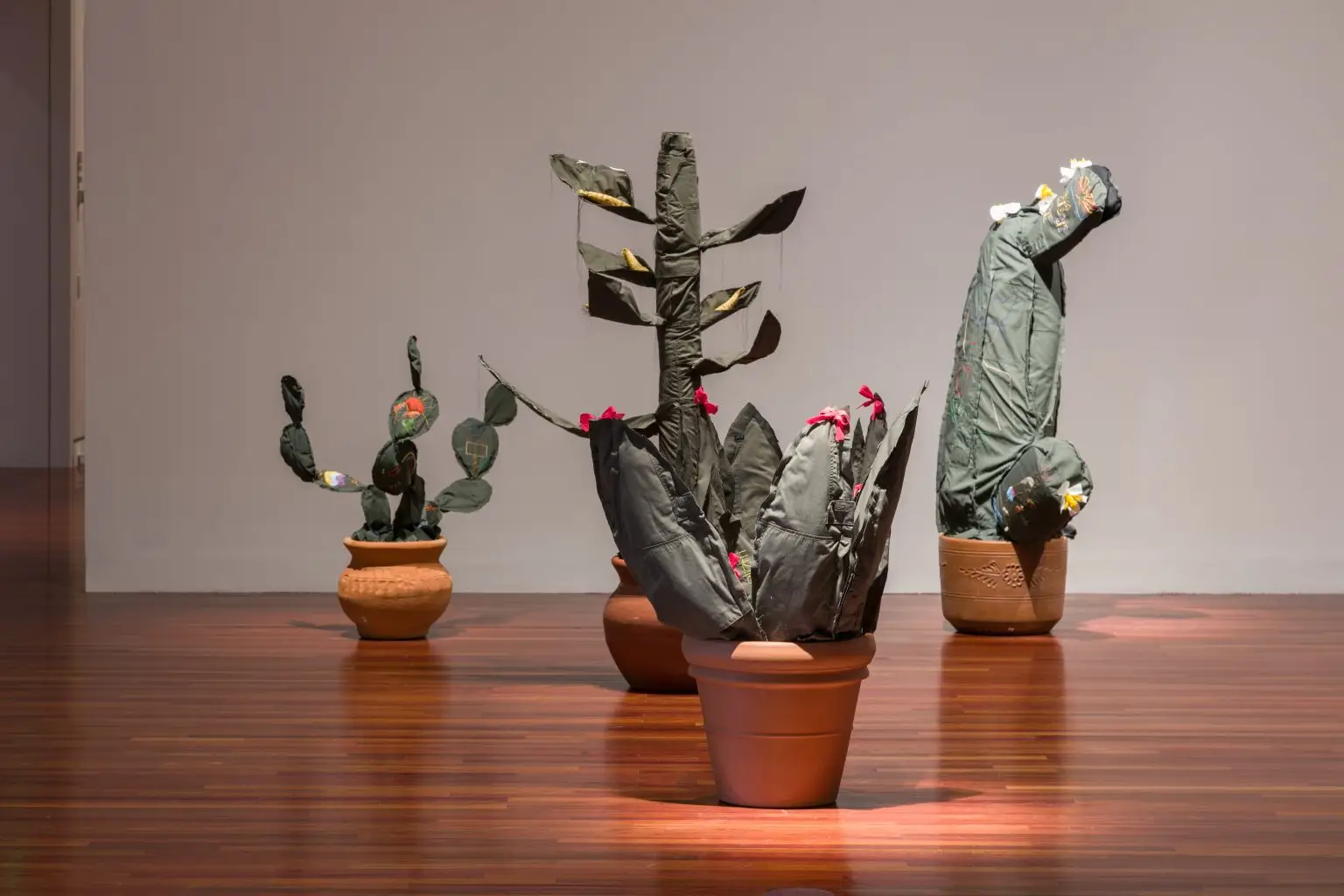
Cacti and other Southwestern plants made from repurposed U.S. border patrol uniforms sprout up from flower pots in the El Pomar Gallery at Colorado College’s Fine Arts Center.
One of the soft sculptures is embroidered with the phrase “shared pain” beneath two broken hearts, fitting together like puzzle pieces. “Comunidad” is embroidered on an adjacent portion of the cactus. A joshua tree in the gallery is embroidered with military patches and the phrase “die for the rich.” Another is embroidered with stick figures, a heart and the phrase “la familia.”
The exhibit is part of an ongoing project, The Space in Between, by artist and activist Margarita Cabrera and is one of two collaborative projects by Cabrera on display at the Fine Arts Center (FAC) through Dec. 13.
Created in collaboration with communities across the country over the past 15 years, The Space in Between is the result of workshops led by Cabrera where individuals and families come together to craft the sculptures and embroider their stories of immigration and migration.
“[The project] invites people with different perspectives on immigration to deconstruct uniform fabric that to some represents safety, security and control, while to others it represents family separation, detention, systematic violence,” Cabrera wrote in a recent Instagram caption. “Working collectively we construct new sculptural forms with uniform material that represent nature, growth, and flourishing as a form of resistance.”
Eight new additions to the project, currently on display in the Fine Arts Center, were created in Colorado Springs.
“It felt humbling to bear witness to people’s experiences,” says FAC Museum Director Michael Christiano of coming in and out of the workshops. “And humbling for people to trust you with their stories.”
‘Hopeful spaces’
Several pots sit empty, representing the stories left untold.
“We had a really hard time getting community participants to come and participate in these workshops,” says Nancy Ríos, the college’s director for belonging and engagement and one of the curators for the exhibit, of trying to organize the workshops in the immediate aftermath of the 2024 election. “Organizations, even then, were reporting people being afraid to come and seek services.”
For Christiano, the collaborative nature of the work — which ultimately involved students, faculty and staff and members of the broader Colorado College community — represented “hopeful spaces in the face of what felt like really difficult, vengeful forces.”
“People can come together and create spaces that function as areas of mutual support,” he says. “The art became a vehicle for that.”
The workshops began with storytelling and then participants and students worked together to craft the sculptures, with the embroidery style inspired in part by Indigenous Mexican folk art.
“You come together, and you’re sharing your own immigration story, you’re connecting with your community, and you’re working together to put these cacti together,” Ríos says. “The embroidery is typically your own, but the actual construction actually requires many hands. “
Ríos crafted a flowering cholla cactus, native to Southern Colorado, with her children as part of the workshops. One of her sons embroidered a butterfly on the cactus to represent migration. Her younger son stitched a dinosaurs. Ríos embroidery includes an eagle, an important symbol of both Mexico and the Chicano movement, as well as chamomile to represent her father’s grandmother who was a curandera, or healer.
Among her stitchings is also water and sand, which she added after learning her parents crossed the border from Mexico by sea onto the beach near San Diego in the ‘70s before eventually settling in Chicago, where Ríos grew up.
“I had no idea that was part of our story,” she says. “It was really wonderful to kind of connect and share that — any opportunity that allows for me to have a conversation with my parents, or anyone in my family, just ways to start conversations that you don’t normally have. Sometimes you need something to kind of get that started.”
Nourishing others
In the adjacent gallery, 55 three-foot-long ceramic spoons are arranged facing inward atop a curving, elliptical table. The project is based on the parable of the long spoons, in which those in hell starve trying to feed themselves with the unwieldy utensils while those in heaven thrive by feeding one another.
“The moral of the story: nourishing others as a way to nourish yourself is the inspiration” behind the project, Cabrera wrote in an Instagram post.
The project, CARE, was conceived in collaboration with Longmont’s Ollin Farms. The spoons, created with local farmers and other community members, vary in style, color and content. One of the spoons features bees and honeycombs while another sprouts mushrooms and another still has a small mug and representations of other manmade items.
“Each one of the 55 spoons is really, really different,” says Christiano. “It’s representative of that person’s unique relationship with the land, with food consumption, production, food histories, perhaps, and their families, those kinds of things.”
The table allows participants to stand on either side of it to view the pieces.
“There’s a kind of intimate relationship that exists at either end of the object by nature of just imagining a vulnerable gesture of feeding someone, which is so intimate and so tender and so awkward,” Christiano says.
The museum plans to co-organize a program in November with regional groups working in food equity and access to “introduce our community to the network activity that’s currently underway” in that space, Christiano says. Details on that event are tbd.
“Museums can be platforms for conversation that lead to other things,” Christiano says. “Seeing people come together to have those conversations in a way that leverages the work’s ability to speak to those issues… feels really important and powerful.”