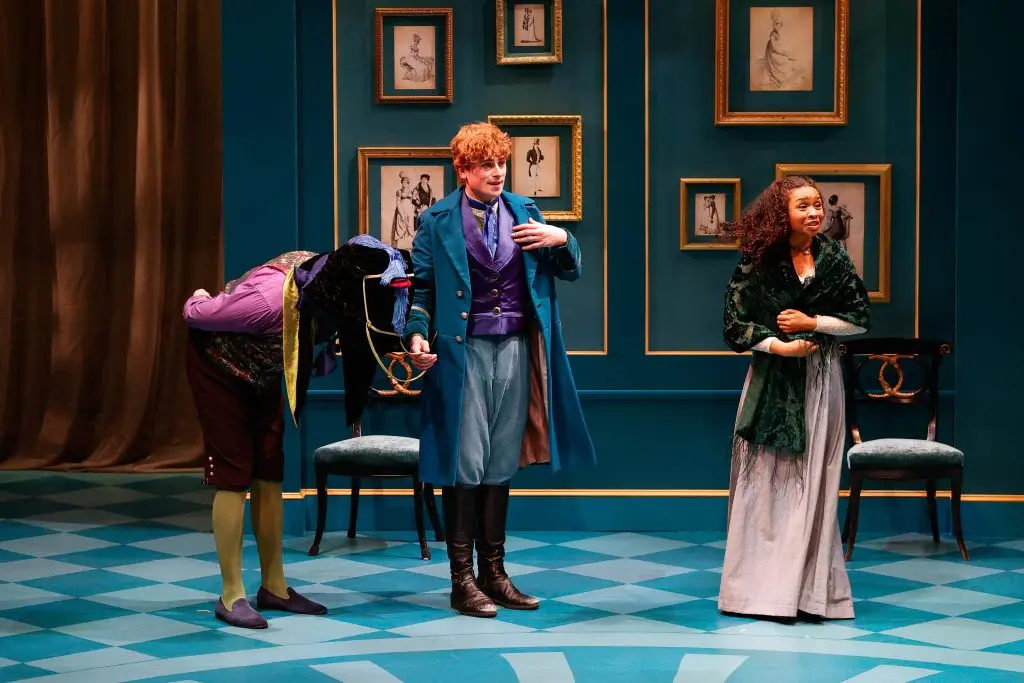
Much to Murray Ross’ dismay, the atmosphere of the Ramblin Express bus was more like that of a Broncos shuttle, all bubbly and talkative.
The passengers had boarded at twilight at The Mining Exchange hotel for a Theatreworks production of the 15th century play “Everyman,” a Christian allegory about its titular character’s journey to the afterlife.
The bus wasn’t taking its passengers to the theater; they were already on set.
Characters would get on and off the shuttle at each stop, confronting the allegorical Everyman — who was portrayed by multiple actors of differing demographics — about their life.
As the bus drove through the dark streets in between scenes, a curated playlist of Frank Sinatra, The Beach Boys, Mumford & Sons and a little bit of Gregorian chant played over the speakers.
After one particularly chatty audience, Ross imposed an order of silence in future performances, inviting the audience to pretend that they’d entered a Carthusian monastery.
“Watching the smiling faces leave the bus last night, I realized they had missed out on something: a contemplative experience,” Ross wrote on his blog the morning after. “The most interesting and resonant moments of the entire journey are when nothing is happening, when you are sitting, looking, listening and waiting for the next scene, when you are spending time suspended in between.”
Still, Ross never had any troubles with setting the tone when the bus arrived at its final stop: a cemetery where an angel, singing an aria, waited to welcome the passengers.
Former UCCS chancellor Pam Shockley-Zalabak remembers the night the show closed in 2013. She was at a fundraising event with Ross and several other staff members.
“Murray said, ‘Pam, I’m going to leave for a little while because I want to be on the bus one last time,’” Shockley-Zalabak recalled. “He just went and experienced it. But that’s what he was always doing. He wanted to experience things to understand how the rest of us might experience it.”

INSIDE THE CROW’S NEST
The roads weren’t paved, the student body was growing and the staff was tiny — everybody knew everybody.
When Shockley-Zalabak moved to Green Mountain Falls in 1976, UCCS was entering its eleventh year. In search of a teaching gig, she called the university. She was hired over the phone and began as an honorarium instructor three days later.
Ross, who had accepted a position teaching literature the previous year, worked in the same building. The pair became fast friends.
“We refer to it as the Wild West, entrepreneurial startup days of UCCS,” Shockley-Zalabak recalled. “We were wanting to do things that people in more traditional, more mature university environments would never be able to do. … You had to support what you wanted to do and why. And there were limited resources, so it had to work, or it got discontinued.”
Ross’ dreams were even bigger and crazier than his head of hair (which inspired the name of a rehearsal room in the Ent Center for the Arts — The Crow’s Nest). In 1975, he established UCCS’ theater program and their professional theater company, Theatreworks. Two of Ross’ visions — to make Theatreworks a unionized theater company and to establish an arts center on the UCCS campus — eventually came to fruition.
Theatreworks’ first production, a German dark comedy about arsonists called “The Firebugs,” was staged in the basement of the cancer ward at Penrose Hospital.
At that time, Theatreworks was run on goodwill, passion and a lot of volunteer hours. 
There may have been even a little child labor involved, joked Orion Ross, Murray’s son. He was first a child actor, then a stage manager, then a lighting designer — whatever was necessary for a given production.
“I feel very lucky to have grown up in a theater,” said Orion. “It was such an exciting window into not just the world of adults, but art and literature as well.”
Orion remained a theater kid throughout high school and college before delving into the world of television production. Now, he’s the vice president of International Animation at Disney Branded Television.
“I do sometimes miss the immediacy and the deadline and the sense of community that you get in theater,” Orion admitted. “It takes a lot longer to make an animated series than it does to rehearse and put on a play.”
Orion wasn’t the only member of Ross’ family who was drafted into Theatreworks. Betty Ross, Murray’s wife, was Theatreworks’ co-founder and costume designer in those early days.
The contrarian couple enjoyed heated debate both in the theater and around the dinner table.
“If somebody seemed too self-assured or self-satisfied, even if they agreed with them, they’d feel like, ‘We need to challenge you because we need to make you defend your idea,’” Orion explained.
The Ross family first moved to Colorado Springs after a year living in London. Much of Murray’s family lived in the UK, and he and Betty were devoted Anglophiles. Orion suspects that Theatreworks’ annual London tour — where theater lovers and UCCS students see six plays over the course of 10 days — was originally conceived as a way for his dad to visit London once a year, enjoy its theater and fundraise for Theatreworks in one fell swoop.
Although Murray and Betty Ross considered themselves nomads, they loved the community they built in Colorado Springs enough to put down roots.
“Murray’s drive has led UCCS to think about and utilize the arts the way many universities view their athletic program,” explained David Siegel, executive director of the Ent Center for the Arts. “Murray created the theater community that we enjoy in Colorado Springs today.”

ROOM FOR ENT
Over the decades, Theatreworks established itself as a company known for challenging theater — in both themes and staging. But being scrappy and recourceful only went so far. Whether it was in setting up a wrestling ring for “The Elaborate Entrance of Chad Deity” or a tent for outdoor Shakespeare, Theatreworks often found itself feeling cramped. They spent many years housed inside the Dwire Hall auditorium, where the audience sat at writing desks in plastic seats, and the entire backstage was stuffed into a storeroom.
Clearly, a new venue was needed. Murray Ross envisioned a community arts center on the UCCS campus with a theater to meet all of Theatreworks’ needs: a large yet intimate space, flexible enough to stage anything, complete with a trap underneath the stage.
Ross and Shockley-Zalabak shared that dream since the early aughts, but it wasn’t until the 2010s when the dream started to become reality.
UCCS had worked since 2001 to stabilize its budget and expand its enrollment and program offerings, so when the financial crisis hit in 2008, UCCS bounced back quickly compared to other universities.
“Around 2012, 2013, our facilities director said, ‘We have some embryonic plans for the performing arts center. … It looks like there may be, at the end of the legislative session, some small amount of state money that we could go for to begin our planning and to actually begin this process for real,” remembered Shockley-Zalabak. “I said, ‘Are you kidding me?’”
UCCS agreed to match $10 million from the state before spending any money on the project. A team was able to raise the initial funds, and over time, the $70 million Ent Center for the Arts was built.
The Ent Center opened in Feb. 2018 — 13 months after Ross died following a brief illness. He was 74 years old.

ACTING IN AND OUT
Caitlin Lowans became Theatreworks’ second-ever artistic director six months after Ross’s passing.
“I was really grateful to have in that transition so many people who knew Murray very well as an artist, who had collaborated with him. … These folks really helped me understand what I was inheriting and what I had to preserve,” Lowans said. “It’s a really enormous responsibility to inherit from a founder and inherit at a time of grief because losing a founder unexpectedly, and to death rather than to retirement, means that people were thinking about the transition of Theatreworks, but also grappling with mortality and loss of a beloved mentor and artistic partner. So, it was really complicated, and I think complicated by the fact that Murray and I didn’t cross paths.”
Adding to the complications was the COVID-19 pandemic, which forced Theatreworks to cancel their production of “An Iliad.” But, similar to Ross before her, Lowans’ ethos of risk-taking paid off. Theatreworks put on virtual productions and, in Feb. 2021, staged Ukrainian fable “The Mitten” as a shadow puppet show that socially distanced groups would view by traveling throughout the Ent Center.
Lowans also created the ACT OUT series in 2019, which continued after the pandemic. The series of summer productions brought Shakespeare out of the theater and into community spaces like parks, libraries, community centers and schools, entirely for free.
Lowans had plenty of fond memories of the program, from a servant character in “The Comedy of Errors” sitting and eating Cheetos with a six-year-old in the crowd to the audience at Springs Rescue Mission weeping during a tender scene in “Pericles.”
Lowans left Theatreworks in Feb. 2025 to accept an artistic directorship at the Ten Thousand Things Theater in Minneapolis, Minnesota.
Because resources were tight during the COVID-19 pandemic, Lowans took on many administrative responsibilities for Theatreworks, despite being the artistic director. It’s not how Theatreworks had historically functioned, and the university recognized that continuing to place so much responsibility on one person wouldn’t be healthy for the artistic director or Theatreworks as a whole.
The general director role was created to handle administrative responsibilities. The interview process will begin at the end of this month.

MAXIMIZING THEATREWORKS
Max Shulman had his first encounter with Theatreworks when he was hired as a professor in Theatreworks’ theater and dance program in 2015. Murray Ross was on the team that hired him.
Shulman characterized Ross’ philosophy as a balance of highbrow academia and the practical challenges of creating theater. Shulman’s background is similar; he worked as an actor and director for over a decade in New York City before pursuing his doctorate in theater history at Tufts University.
Shulman’s collaborations with Theatreworks continued over the years as he directed plays like “Henry IV & V,” an abridged adaptation of Shakespeare’s monarchic saga.
Shulman was named Theatreworks’ third artistic director in April 2025, and has been hard at work on Theatreworks’ upcoming 50th anniversary season since then.
The season, which was designed by Lowans, is a mix of classics and new work beginning with the rambunctious “Cabaret” in September. The Dusty Loo Bon Vivant Theater will be set up as though it were the Kit Kat Club, with the audience seated onstage and mingling with the cast as part of the show.
“Cabaret” is followed by Oscar Wilde’s “The Importance of Being Earnest” and the relatively unknown “Where We Stand,” a fable about forgiveness staged as a town hall meeting, with the audience deciding the central character’s fate at the end of each performance.
In a full-circle moment, Max Shulman will usher in the next 50 years of Theatreworks by directing “Romeo & Juliet,” the first Shakespeare Theatreworks ever performed. The key to his production, Shulman teased, will be creating a pressure cooker atmosphere that justifies the young lovers’ recklessness.
The season ends with “The Garbologists,” a recent comedy about two sanitation workers in New York City. Theatreworks’ set designers will have to, somehow, recreate a garbage truck onstage — a fitting challenge for the company that once staged a production on a bus.
“These are plays that speak to the history of Theatreworks,” Shulman said. “At the same time, there are plays that speak to what Caitlin accomplished in her last six years, which was ambitious, contemporary and really of the moment theater.”
Lowans’ ACT OUT series has been put on pause to evaluate its financial sustainability, but Shulman is already at work ensuring that Theatreworks will remain accessible through community collaborations.
“I’m a firm believer in the idea that a healthy democracy is measured by its theater, and that accessibility in theater is key,” he said.
That democratic attitude is at the heart of Shulman’s directorship.
“I want to ensure that we’re creating a theater that speaks to as many people as possible [by] ensuring that we’re really promoting plays that balance entertainment with enlightenment,” Shulman said. “I’m really excited about what I’m calling theater of the emerging American moment: theater that speaks to us right now, theater that celebrates some of the American canon in new ways, plays that resound over the decades and allow us to think about the place that our nation sits in right now, that offer us ways to both critique and be proud of who we are and where we’re from.
“I am really interested in maintaining the inclusivity and diversity of this theater as it has existed over the years,” he added, “Both in its point of view [and] in the kind of people it shows onstage.”
Shulman is equally dedicated to ensuring that the UCCS students he’s taught over the past seven years feel they have a home at Theatreworks.
But Shulman is thinking far past the 50th season. He’s already thinking years in the future — after all, you can only accomplish so much in five productions per year.
“I don’t think you get measured by a single season or a single program,” he said. “I think the way to engage with people is to open the door, make sure it’s open wide enough for everybody, and produce really great work.”
David Siegel agrees.
“My hope and belief is that Theatreworks will continue to grow and evolve. A theater company is a living organism, and we are shaped by the past 50 years, but we’re really excited for the next 50 years under Max and others’ leadership,” Siegel said. “I think the world needs great art and great theater right now more than ever. Theater helps us understand who we are.”
